
Problem
The information discovery gap between those who know and those who can act
Prediction markets have shown that markets are highly effective at surfacing accurate information. However, their design requires all price data to be publicly available. This transparency prevents the emergence of markets that offer a competitive edge.
As a result, companies are not willing to supply the 'dumb money' needed to incentivize participants to share their information, because any valuable signal they help generate can be freely exploited by competitors.
Competitive advantage is central to business, and advantages arise from the ability to detect quality information early. This implies that there is naturally a gap between those who discover these opportunities and those who have the ability to act on them.
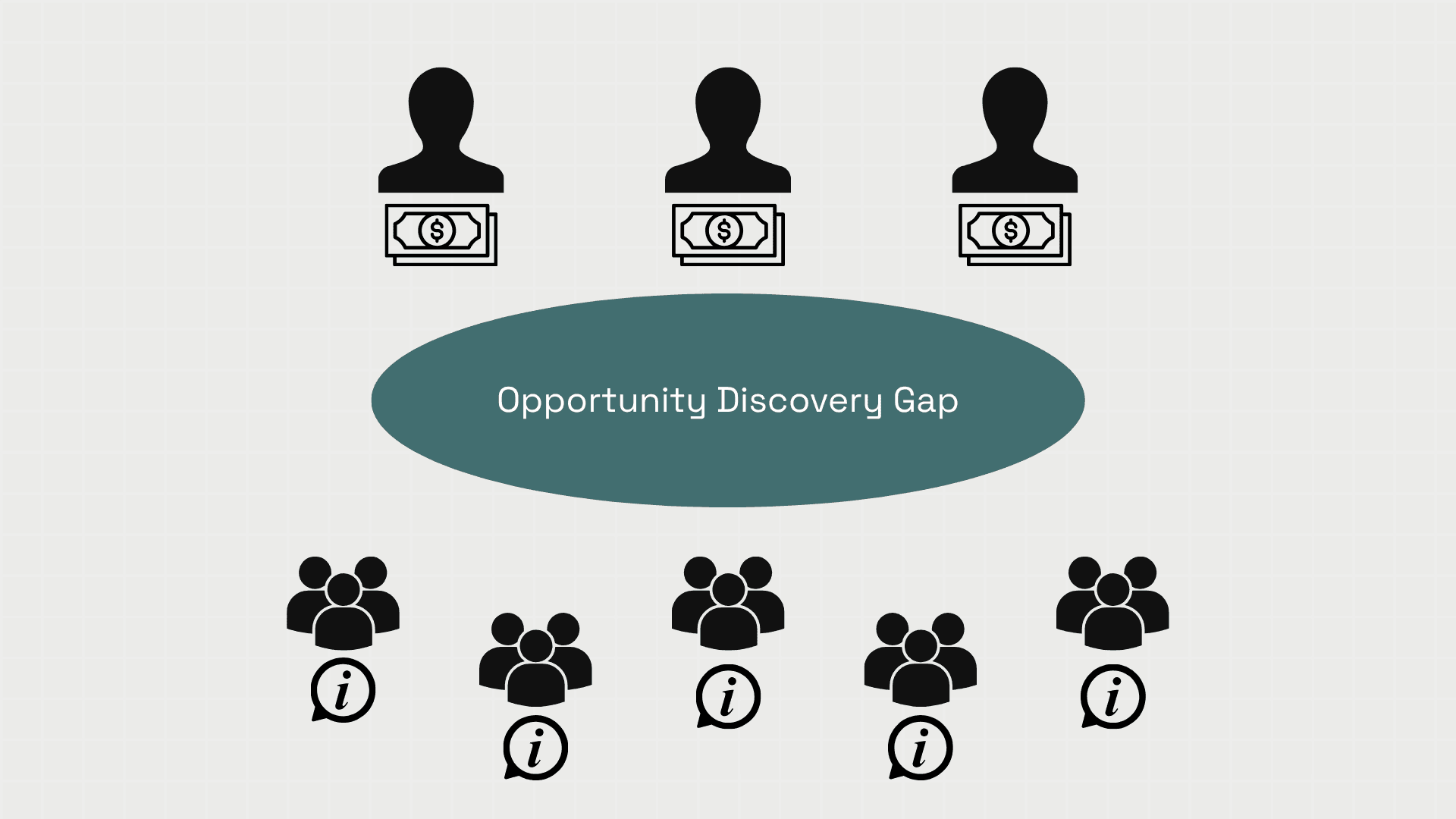
Decision-makers rely on high-quality information to make the best possible choices. Recruiters search for talent, investors for promising companies, music labels for the next breakout artist, and sports clubs for exceptional players.
Opportunities are everywhere in people's everyday life. Somebody knows someone who's looking for a job, has a friend who's a gifted musician, or sees potential in a child who could become a top athlete. Yet there is no effective way to surface these insights to the people who could act on them. There's no reliable system to collect this kind of information or to distinguish meaningful signals from noise.
Current Solution
To bridge the gap, parties that require this information have come up with methods to identify opportunities early. Sports clubs hire scouts and rely heavily on automated data, recruiters work with agencies and software that filters applicants for them.
Even though every sector has established workflows to identify opportunities, these systems are far from perfect, and blind spots inevitably exist. Market-based infrastructure optimizes the process of discovering new opportunities and uncovers value that traditional workflows may miss.
Side Note
It's important to note that, unlike the Futarchy model, we don't view flawed human judgment as the core issue. Instead, we see the primary problem as the limited access decision-makers have to high-quality information.